Thanks! We received your information and will contact you within 24 business hours. Check your inbox: we sent you the link to book a free call.
Prefer to talk now? Message us on WhatsApp.
Understand search engine optimization, the work it involves and how to measure progress without confusing rankings with business results.
SEO stands for search engine optimization. It is the practice of improving a website so search engines can discover and understand its pages and people can find useful answers through unpaid search results. The work combines technical improvements, relevant content and earned credibility, with the aim of attracting the right visitors and supporting business goals.
SEO connects a question with a useful page. Someone might search for a local repair company, compare software or investigate a problem before deciding what to buy. Your website needs an appropriate answer for each relevant stage, rather than a repeated sales pitch.
Consider a fictional appliance repair business. A service page could explain refrigerator repair in the cities it actually serves, while a guide could explain when a leaking refrigerator needs professional attention. These pages serve different needs. Both should make the company’s service, experience and next step clear.
The objective is qualified demand: inquiries, purchases or other valuable actions from people the business can help. More traffic can be useful, but visits from the wrong audience may contribute little.
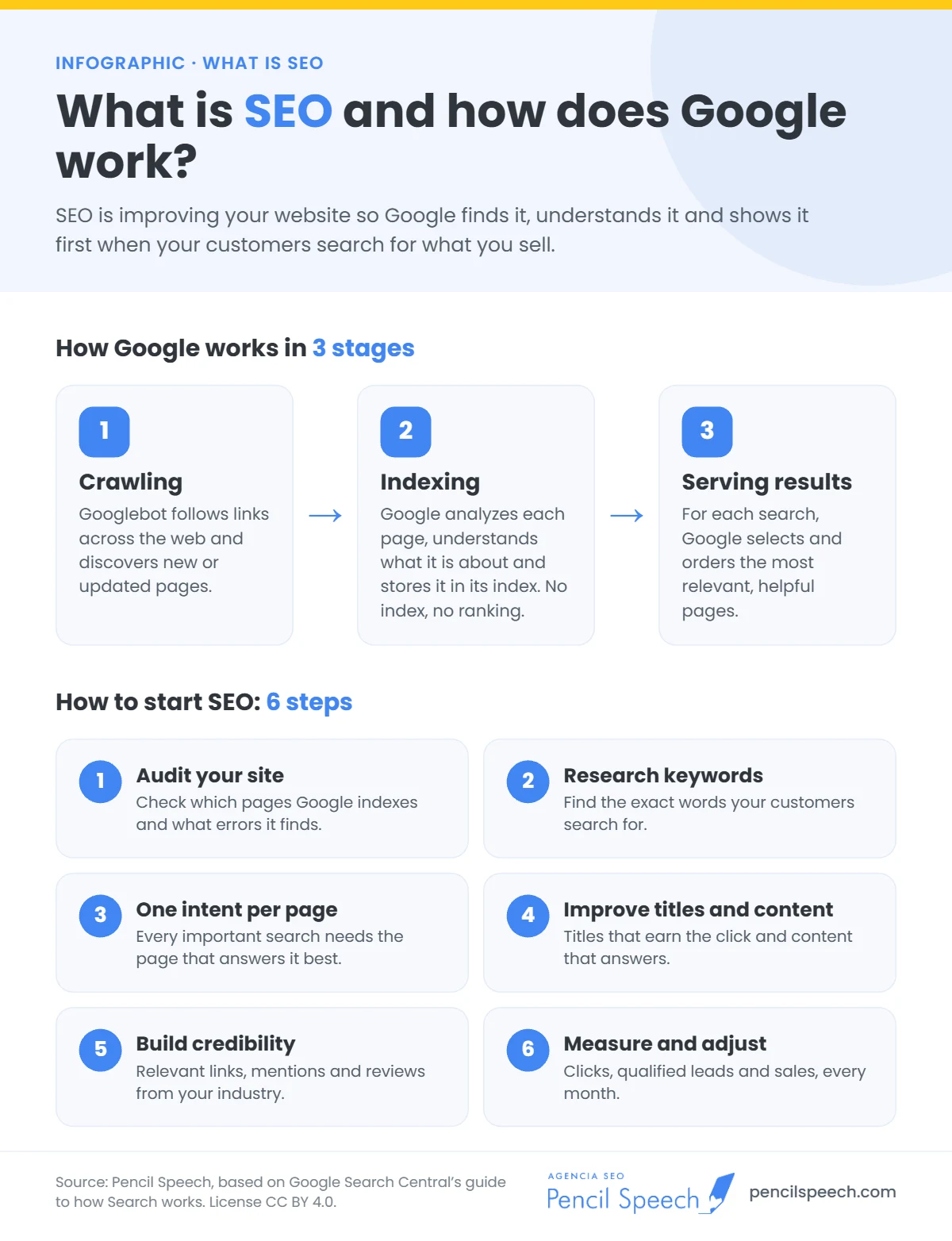
Google describes three broad stages in how Search works. They help explain why publishing a page and seeing it in results are different things.
SEO helps remove obstacles at each stage and makes the page more useful. However, discovery does not guarantee indexing, and indexing does not guarantee a particular position. Read Google’s explanation of how Search works.
| Area | What it covers | Example deliverable |
|---|---|---|
| Technical SEO | Access, indexing, redirects, canonical URLs, rendering and site performance | A prioritized issue list with verified fixes |
| On-page SEO | Page purpose, titles, headings, internal links and clear content | An improved service page matched to search intent |
| Content strategy | Which questions to answer and which pages to create, improve or consolidate | A page map and editorial priorities |
| Off-page SEO | Relevant mentions, links and reputation earned outside your site | Useful resources and legitimate outreach |
| Local SEO | Visibility for businesses serving real locations or service areas | Accurate business information and location-specific pages |
These areas overlap. A strong article cannot help visitors if a broken redirect prevents access, and a technically accessible page still needs something useful to say. Do not buy links or manufacture reviews to imitate credibility.
SEO works on eligibility and relevance in unpaid search results. Paid search places ads through an advertising platform and requires a media budget. Paying for ads does not buy a better organic ranking.
Paid campaigns can help test messages and capture existing demand while SEO work develops. Organic visibility may continue after an individual content update, but it still requires maintenance. Neither channel is free of effort or automatically profitable.
The term SEM is used in different ways: some use it for search marketing overall; others mean paid search specifically. When comparing proposals, ask which activities, advertising spend and implementation work are included.
For the phases, responsibilities and deliverables behind this work, see our SEO project guide. Start with a manageable group of pages instead of expanding a blog before the core offer is clear.
Use more than one level of measurement. A position change is useful context, but it does not tell you whether a visitor became a customer.
Search Console clicks and analytics sessions measure different things and should not be expected to match exactly. Third-party traffic estimates are another category of data; they are not your actual visitor or sales totals.
Compare equivalent periods and account for seasonality, campaigns and site changes. Document the scope of a result before attributing it to SEO. Our SEO tools and software guide explains where each tool fits.
There is no universal deadline. The site’s starting point, competition, resources and speed of implementation all affect progress. Fixing an indexing mistake and building demand for a new website are very different assignments.
A real example of the timeline: Laboratorios Farma, a pharmaceutical client of Pencil Speech, grew from about 1,612 to about 140,000 estimated organic visits a month between August 2019 and October 2026.
Source: Ahrefs organic traffic estimates (third-party model, not the client’s analytics). The growth came from years of compounding work, not a single change.
Ask for milestones the team can control: completed research, published improvements, verified fixes and reporting. Treat forecasts as assumptions to review, rather than guaranteed dates for reaching a ranking or sales target.
SEO budgets should distinguish diagnosis, writing, development, implementation and ongoing measurement. A low fee with no execution support may not be comparable to a proposal that includes all of these. See our SEO audit cost guide for the questions to ask when comparing audit proposals.
AI-generated answers change how people discover information and how publishers evaluate visibility. A useful approach still starts with accurate, accessible content and a clear explanation of who the business is and what it offers.
Google’s guidance for AI features connects their inclusion with foundational SEO practices. Check the current requirements for the specific search surface you are targeting; no formatting shortcut guarantees a citation or recommendation. A mention, a referral visit and a qualified lead are separate outcomes.
For help connecting website improvements with this broader visibility work, see our AI SEO services.
A sensible priority is the issue that most affects customers and business outcomes, not the warning with the brightest color in a dashboard.
You do not pay Google for an organic click, but research, content, development and measurement require time or budget. Free tools can support the work; they do not perform every task for you.
You can learn the fundamentals and improve a small site yourself. Bring in specialist support when technical changes, migrations, complex measurement or limited internal resources make it useful.
No fixed publishing frequency suits every business. Improve the pages that answer real customer needs and keep important information accurate. A useful service page may deserve attention before another article.
A plugin can help manage metadata, sitemaps and other settings. It does not replace a strategy, reliable content, technical judgment or implementation checks.
No agency controls Google’s organic results. Ask for a clear scope, transparent evidence and measurable business priorities rather than a guaranteed position.
A useful strategy connects the searches your customers make with pages that explain your offer and help them take the next step. Pencil Speech can help prioritize the work, implement improvements and measure results.
Message us on WhatsApp Talk to Pencil Speech
See what is included in our SEO services and our SEO pricing.
Updated in November 2026. Original authorship: Juan Sanoja. The appliance repair example is illustrative. The Laboratorios Farma figures are Ahrefs estimates for a real Pencil Speech client.

Graduated in Social Communication magna cum laude from the Central University of Venezuela. I like to find the why behind things. The best way to understand a subject is by explaining it. SEO Consultant at Pencil Speech.